Nursing Administration & Leadership Programs in Michigan

Compare MSN, DNP, and certificate paths at Michigan colleges by format and cost

Reviewed by NurseAdministrator.org TeamUpdated October 2, 202619 min read

What you’ll learn in this article…

  • Michigan State University lists its online MSN-to-DNP leadership pathway at 28 credits and $900 per credit.
  • Eastern Michigan University's DNP is CCNE-accredited through December 2027, so verify each program's status for 2027.
  • Michigan RN licensure runs through MiPLUS, requiring the NCLEX-RN, a fingerprint check, and implicit bias training.

A four-course certificate at the University of Michigan-Flint and a 65-credit DNP at Andrews University both count as nursing leadership education, yet they lead to very different roles.

For a Michigan RN ready to move from bedside care into nurse manager, director, or executive work, how to become a nurse administrator starts with matching the credential to your starting degree. These nursing administration and leadership programs are all Michigan-based, each labeled by credential and delivery format.

Online coursework is common, but practicum is not optional: Baker College requires 405 clinical hours and Madonna University 420.

Best Nursing Administration and Leadership Programs in Michigan

These are the graduate nursing administration and leadership programs offered by Michigan colleges in our directory, covering MSN, DNP, and post-master's certificate options. Each card is labeled by credential and by delivery format as the program reports it. If a school you are looking for is not listed here, it is not in our directory; for online programs nationwide, see our MSN in nursing administration guide.

Factors considered
  • Student-to-faculty ratio
  • Median graduate debt
  • Accreditation status of the program
  • Tuition and typical net price
  • Clarity of program format and requirements
Data sources
  • Independent program research
  • National Center for Education Statistics (IPEDS) — nces.ed.gov
  • Internal program database

MSN vs. DNP vs. Graduate Certificate: Which Leadership Credential Fits You?

The practice doctorate has quietly become the expectation for system-level nursing executives, while the MSN remains the workhorse credential for the manager and director roles that actually run Michigan's units. Choosing between them is less about prestige than about which chair you want to sit in five years from now.

The MSN: manager and director track

An MSN in nursing administration or leadership is built for the charge nurse or clinical coordinator moving into nurse administrator duties and responsibilities as a nurse manager, unit director, or service-line leader. Credit totals vary widely by school. Oakland University's online Clinical Nurse Leader MSN is listed at 36 credits over roughly 18 months part-time, while Grand Valley State's MSN carries 63 credits. Wayne State's MSN typically runs two years full-time or three part-time. Ferris State, which offers a Nursing Administration concentration, expects most students to take one or two courses per semester and allows up to five years to finish. Madonna's administration MSN requires 420 supervised practicum hours.

The DNP: executive and system leadership

If your target is chief nursing officer, VP of patient care services, or a system quality executive post, the DNP is the credential built for those roles and the one aligned with the nurse administrator salary band. Michigan post-MSN DNP programs generally fall in the 28 to 36 credit range and take 18 to 36 months. Madonna's post-MSN DNP is 33 credits and can be finished in as few as two years; UM-Flint's post-MSN DNP sits at 30 to 34 credits, though length shifts with your background, prior coursework, and advising approval. BSN-to-DNP pathways are a much larger commitment: roughly 70 to 95 credits, at least 1,000 clinical hours, and three to four years full-time.

The post-master's certificate: adding a specialty

Do you already have an MSN in education, informatics, or a clinical specialty? A post-master's leadership certificate layers administrative coursework on top without repeating core graduate content. These typically run 12 to 15 credits over about a year, though programs with heavier practicum requirements can stretch considerably longer.

Rules of thumb

  • Staff nurse aiming at management: the MSN gets you there, and it satisfies the graduate-degree requirement behind the major nurse executive certifications.
  • Director eyeing the C-suite: go post-MSN DNP; it is the shortest doctoral route and the one hiring committees recognize.
  • MSN-prepared nurse pivoting specialties: the certificate is the efficient move, not a second master's.

Admission Requirements for Michigan Nurse Leadership Programs

Michigan programs have no uniform admission standards, and criteria shift each admissions cycle. Use this checklist to plan, then confirm every item on the program's own page.

  1. Active, unencumbered RN license
    Every program we reviewed requires one. Michigan State asks for a current, unrestricted license (with a Michigan license if you practice in the state). U-M Flint's executive leadership DNP asks for an unencumbered U.S. license. U-M Ann Arbor requires licensure in the state where you complete clinicals.
  2. BSN, or an RN-to-MSN entry option
    U-M Ann Arbor and Michigan State require a BSN. U-M Ann Arbor lets you apply before finishing it, but the degree must be conferred before you enroll. U-M Flint's DNP requires both a BSN and a master's. The research did not confirm an ADN-entry route for these leadership programs, so ADN nurses should compare RN-to-MSN options school by school.
  3. Minimum GPA
    Expect roughly 3.0 to 3.2. Michigan State uses 3.0 on credits from the second half of the BSN. U-M Flint uses 3.2 for both undergraduate and master's work. U-M Ann Arbor does not publish an official minimum.
  4. RN or leadership experience
    Requirements range widely. U-M Flint wants 24 months of full-time mid-level administration or higher within the last five years (a faculty or executive-consultation alternative exists), plus 30 hours of nursing-administration continuing education within three years. Michigan State prefers nursing experience but sets no fixed minimum. U-M Ann Arbor lists no minimum.
  5. GRE policy
    Most programs have dropped it. U-M Ann Arbor and Michigan State do not require it. U-M Flint's policy was not stated, so check before you register for the test.
  6. Statistics prerequisite
    Michigan State wants a 3-credit undergraduate statistics course (2.0 or higher) or a graduate course (3.0 or higher) completed within five years. U-M Ann Arbor lists no prerequisite and teaches applied statistics in the first semester.
  7. Application materials
    Plan on a resume, a goal statement and references. Full document lists and deadlines were not confirmed for every program, so verify them on each admissions page.

Cost and Financial Aid for Nursing Administration Degrees in Michigan

Per-credit rates show the real cost of a Michigan nurse administrator master's program better than a single tuition figure. Michigan State University lists its online MSN-to-DNP leadership pathway at 28 credits and $900 per credit plus fees, roughly $25,200 before fees. Spring Arbor University lists its online DNP in Strategic Leadership at $892 per credit, and Baker College's online MSN in Nursing Administration runs 36 credit hours. Andrews University advertises a 50% per-credit tuition discount on its 65-credit online DNP, but we do not have the discounted rate. Program-level median debt and monthly loan payments are not yet published for these programs, so the table shows tuition and institution-wide net price only. That net price is an approximate figure for the whole school, not for nursing leadership students, and tuition figures are as listed in each program's data, so confirm the per-credit rate and total credits with the school. Because program-level debt and earnings are not yet published, do not treat school-wide earnings as a program outcome. Ask each admissions office for graduate debt and salary outcomes before you judge return on investment. Employer and federal aid can offset a lot of this. Michigan Medicine's Tuition Support Program has covered 75% of approved tuition, up to $7,307 per academic year (a 2024 to 2025 rate, so confirm the current cap), with manager approval and an accredited program required. Corewell Health, Henry Ford Health and Trinity Health Michigan all offer tuition assistance or reimbursement, but amounts and eligibility vary, and you should ask HR whether MSN and DNP study qualifies. Federally, new graduate borrowers from July 1, 2026 can generally take up to $20,500 per year in Direct Unsubsidized loans, with a $100,000 aggregate cap for first-time graduate borrowers. Grad PLUS is closed to new borrowers, except for a limited interim exception for students already enrolled and borrowing in the same program before July 1, 2026.

SchoolCredential and formatGraduate tuition (in-state)Graduate tuition (out-of-state)Approx. institution net price
University of Michigan-FlintGraduate certificate in Nursing Leadership and Management, online$14,473$21,390$7,007
Ferris State UniversityMSN, Nursing Administration, online$9,538$9,538$8,624
Saginaw Valley State UniversityPost-graduate Nurse Administrator certificate, online$18,360$18,360$10,775
Andrews UniversityDNP, Nurse Leadership, online$29,156$29,156$12,547
Baker CollegeMSN in Nursing Administration, online$11,250$11,250$13,157
University of Detroit MercyPost-master's Clinical Nurse Leader certificate, online$22,544$22,544$15,232
Madonna UniversityMSN in Nursing Administration, online$18,000$18,000$17,755
Spring Arbor UniversityDNP in Strategic Leadership, online$8,364$8,364$19,353

Practicum and Residency Hours in Michigan Programs

Nursing leadership practicums have shifted toward systems-level administrative work, and Michigan programs now describe hours in project oversight, quality improvement, and precepted leadership time rather than bedside shifts. The hour totals vary by credential and campus, so treat the numbers below as program-specific thresholds, not one statewide rule.

What the hour totals look like

Yes, leadership programs require practicum hours, but these are administrative hours, not direct patient care. At the University of Michigan, the post-master's DNP works toward a 1,000 advanced clinical hour benchmark. Up to 500 documented master's-level hours can transfer toward that total, and the current handbook calls for 560 hours through five residency credits.

Eastern Michigan University's DNP expects at least 500 total practicum hours and at least six practicum credits before completion. For the MSN, EMU requires one preceptor for all practicum hours, but available materials do not list a separate leadership-specific hour total.

Michigan State University uses a 500-hour threshold for some pathways: post-graduate DNP students who enter without at least 500 direct-care clinical hours in their MSN take a required course. Confirm whether additional practice hours beyond that threshold are required for the full DNP. Northern Michigan University notes that its DNP practicum can be in your own community with an approved preceptor, but total hour details are not spelled out in the same public materials.

How the AACN DNP benchmark works

DNP programs generally follow AACN expectations for roughly 1,000 post-baccalaureate practice hours and a final DNP project. Michigan schools translate this differently. U-M allows up to 500 prior MSN hours to count toward its 1,000-hour benchmark. EMU documents a 500-hour DNP practicum floor. Because transcript review, project work, and prior graduate credits can affect the final count, ask the program how your specific transcript will be evaluated.

Preceptors and on-campus requirements

Preceptor arrangements vary. U-M arranges preceptors and tells students not to seek placement independently. MSU assigns credentialed preceptors. EMU's MSN requires students to select one preceptor for all hours, while NMU requires an approved community preceptor.

For online and hybrid learners, check face-to-face expectations early. U-M's hybrid format includes required on-campus days each semester. Public materials for EMU, MSU, and NMU do not identify a separately named on-campus immersion or residency, so confirm the schedule before you enroll.

Working nurse tip

Ask whether practicum hours can be completed at your current employer outside your regular paid role, and whether the school will help arrange the preceptor or expects you to identify one. If your regular duties overlap with practicum activities, clarify how paid work and practicum time will be separated.

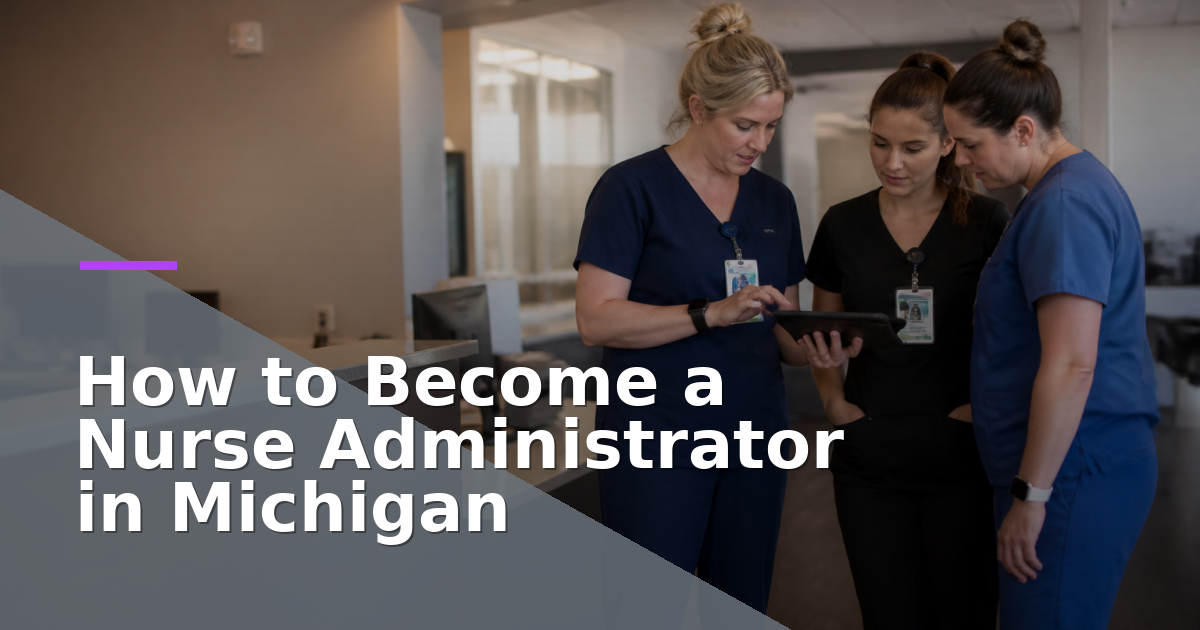
A leadership practicum builds administrative judgment, not bedside skills. You learn to weigh budgets, staffing, and policy decisions by working alongside a nurse executive who makes those calls every day.

CCNE and ACEN Accreditation: How to Verify a Michigan Program

Eastern Michigan University's DNP program is CCNE-accredited through December 2027, and Siena Heights University's MSN Health Systems Leadership holds CCNE accreditation through December 31, 2026. For Michigan nurses weighing a graduate leadership program, that program-level status is the credential that matters most.

Why Accreditation Matters

Accreditation is not a box to skip. It affects whether your degree qualifies you to sit for ANCC Nurse Executive or AONL certification, whether employers recognize the program, whether you can use federal financial aid, and whether you can later pursue doctoral study. Most graduate nursing administration and leadership programs in Michigan hold specialty accreditation through the Commission on Collegiate Nursing Education (CCNE). In the materials reviewed, no Michigan MSN or DNP nursing leadership or administration program appeared in the Accreditation Commission for Education in Nursing (ACEN) directory.

Current CCNE Status for Michigan Leadership Programs

  • Eastern Michigan University: MSN and DNP programs are CCNE-accredited, with the DNP recently receiving initial accreditation through December 2027.
  • Spring Arbor University: Master's, DNP, and post-master's nursing programs are CCNE-accredited; the DNP concentration is Strategic Leadership.
  • University of Michigan - Ann Arbor: Post-Master's DNP (Executive and Practice Leadership) is listed as CCNE-accredited.
  • University of Detroit Mercy: MSN Health Systems Management is CCNE-accredited.
  • Siena Heights University: MSN Health Systems Leadership is CCNE-accredited through December 31, 2026.

If you are considering Wayne State University, verify its MSN directly. The directory excerpts reviewed did not show a current CCNE or ACEN listing for that specific graduate program, so ask the school to confirm current status.

How to Check the Directories

Open the CCNE and ACEN online directories and search by state and institution. Then open the program listing and confirm the specific graduate program is covered, not just the school's BSN. A university may have an accredited BSN while a particular MSN or DNP track is newer or still in candidacy. The directory entry should name the exact credential, such as MSN Nursing Administration or DNP Leadership.

Institutional Accreditation Is Separate

Michigan universities also carry regional institutional accreditation through the Higher Learning Commission (HLC). HLC covers the school as a whole and does not replace nursing program accreditation. For licensure, certification, and employer recognition, confirm both levels.

Michigan RN Licensure Through LARA

Michigan Nursing Administration Programs: Common Questions

Michigan does not set a specific degree or a separate state license for the general nurse administrator role. In practice, you need an active RN license and, typically, graduate nursing education such as an MSN in nursing administration or leadership. Employers set their own requirements, so check postings for the roles you want.

Yes. Among the programs we rank, Saginaw Valley State University lists its MSN Nurse Administrator and its MSN Dual Nurse Educator/Nurse Administrator tracks as fully online. Each program card shows that program's own format. For online options beyond Michigan, see our guide at /msn-in-nursing-administration/.

A nurse administrator is a nursing leadership role with no separate Michigan license. A nursing home administrator must be licensed through the Michigan Department and Board. Rules effective May 7, 2026 require a nursing degree (associate or higher) for RNs, or a bachelor's degree otherwise, plus 9 semester credits or 144 clock hours of approved instruction.

Neither is universally better. An MSN is the more direct route to nurse manager, director, and administrator roles. A DNP in Nursing Administration suits advanced systems leadership, quality improvement, and executive or doctoral-preferred positions. Michigan does not require a DNP for ordinary nurse administrator roles, so match the degree to your target job.

Typically, yes. Graduate nursing administration programs usually include a practicum or residency in a leadership setting, often with a nurse executive or manager as preceptor. Required hours vary by program and credential, so confirm the exact number and placement support on each school's published curriculum before you apply.

Recent Articles